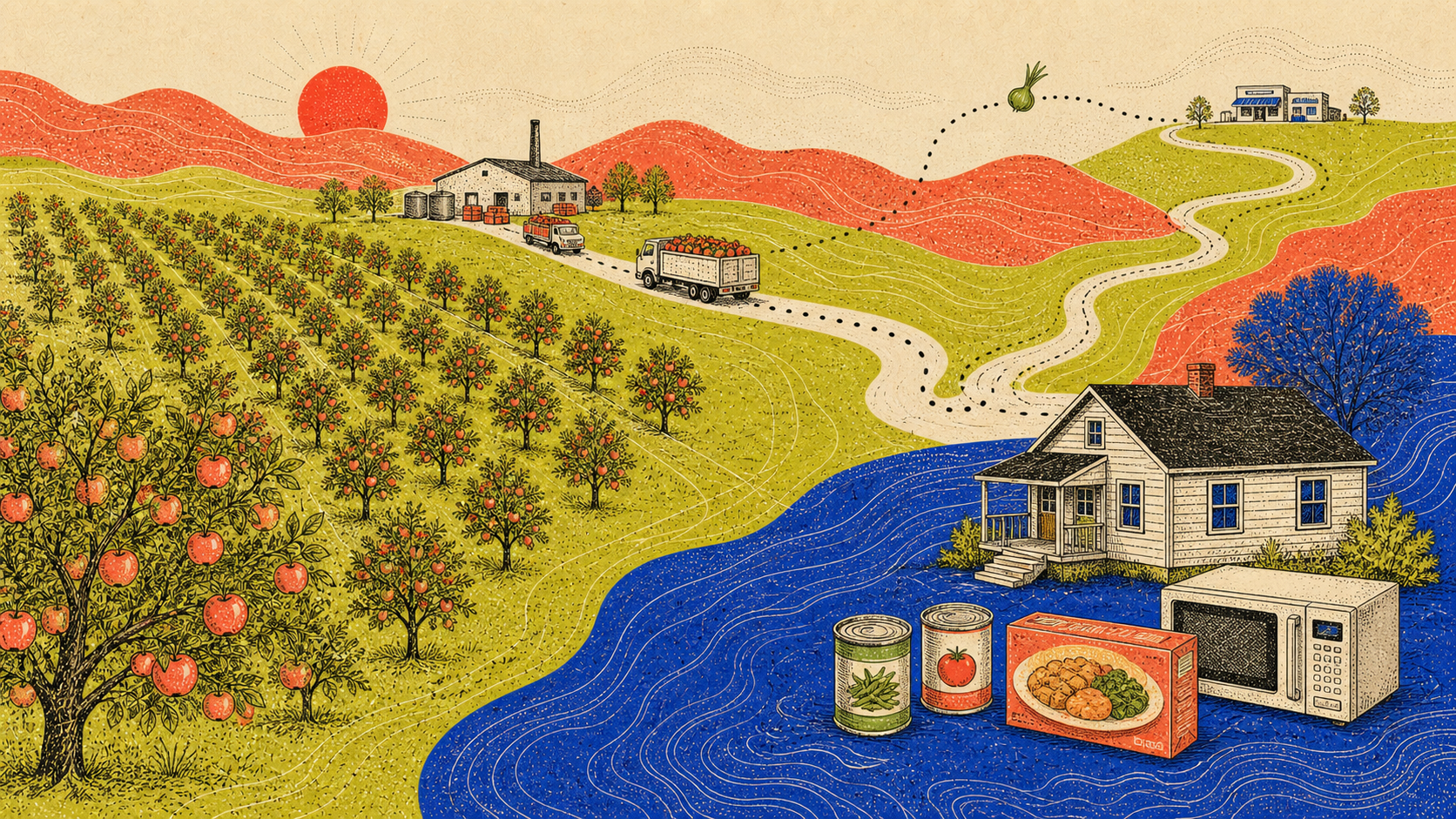
I have never lived in a place with so much farmland. I have also never eaten so much frozen food.
For a while, I lived in a household tucked inside the village of Orrtanna, Pennsylvania, a place whose name still sounds fictional to me. The landscape looked like a postcard of American agriculture. Orchards stretched along the roads. Trucks hauled fruit during harvest. The region has been known as the Adams County fruit belt for more than a century, and just down the road sat a Knouse Foods plant belonging to one of the country's largest fruit processors.
Yet when I needed food, the closest practical option was not an orchard, a farm market, or a grocery store. It was a Dollar General eight minutes away. The nearest Walmart was nearly half an hour away, assuming I was willing to drive through Gettysburg's tourist traffic. A grocery trip was not impossible. It was simply large enough to become a decision.
So my diet slowly changed. Spam. Vienna sausages. Potted meat. Instant ramen. Frozen dinners. I had never eaten so much shelf-stable, ultra-processed food in my life. Every time I opened another can, I found myself thinking: This cannot be good for me. Then: Is it bad enough to justify a one-hour round trip for groceries?
Usually, the answer was no. Not tonight. Not for one onion, or a pepper, or the vague desire to eat something green. The frozen dinner won because it was already there.
My lifestyle changed with my pantry. Cooking became a once-in-a-while activity because there was increasingly nothing to cook with. Dinner stopped beginning with ingredients and began with instructions: open the cardboard, remove the film, place the tray in the microwave or the air fryer. You were golden for the night.
Once, the woman whose house I lived in returned from a farmers market and began putting away her food. She complained that prices had become unreasonable. "We need to afford to live," she said. The sentence stayed with me because the bag on the counter represented everything the landscape promised: freshness, proximity, season, and still arrived home carrying the ordinary anxiety of cost.
"Food access is measured in miles. It is lived in minutes, dollars, energy, and repetition."
The store that is there
Some people I knew had been raised on the food I was only beginning to treat as normal. Their cooking philosophy, as I came to understand it, was: "I do it by the box." I knew houses without a vegetable peeler that somehow contained five different can openers.
That detail would be easy to turn into a joke about people who do not know how to cook. I began to see it differently. A kitchen is an archive of the food system around it. If food arrives in cans, you own can openers. If dinner arrives frozen, the air fryer earns permanent counter space. Skills that are not useful in daily life do not reproduce themselves simply because someone, somewhere, thinks people ought to have them.
In that sense, Dollar General was quintessential rural Pennsylvania infrastructure. It may compete with local businesses; USDA researchers have found that rural independent grocers are especially vulnerable after a dollar store enters their census tract. But the store also solves a problem that criticism does not make disappear. Nothing beats having pet food next to soda, canned meat, and frozen pizza in the same yellow shopping cart. It is good on gas, good on time, often good on money, and, after a long day, good for the mind.
The Dollar General did not need to be a good grocery store. It needed to be eight minutes away.
This is where the language of a "food desert" becomes both useful and insufficient. The U.S. Department of Agriculture maps food access partly by distance to a supermarket, using thresholds of ten or twenty miles in rural areas and incorporating income and vehicle access. Those measurements identify real deprivation. But they flatten the smaller frictions through which a diet changes: the gasoline already low in the tank, the tourist traffic in Gettysburg, the store that closes before work ends, the missing ingredient that does not justify a special trip.
Orrtanna's formal census-tract designation matters less to this story than the experience the category struggles to capture. Food access is measured in miles. It is lived in minutes, dollars, energy, and repetition.
Research using USDA household-purchase data has found that the local retail environment explains more variation in dietary quality for rural households than for urban ones, and that supermarket availability is associated with fruit and vegetable purchases. That does not mean distance mechanically determines dinner. It means the environment keeps placing a thumb on the scale.
Abundance that passes through
What confused me was that Orrtanna did not look deprived of food. It looked submerged in it.
The orchards were not ornamental. They were productive parts of a sophisticated agricultural economy. Knouse describes itself as a grower-owned cooperative of more than one hundred family farms. It processes apples into sauce, juice, butter, pie filling, and industrial ingredients, then sells through supermarkets, schools, restaurants, club stores, dollar stores, military commissaries, and customers in more than three dozen countries. The company can trace fruit back to the orchard and store more than 1.5 million bushels under controlled conditions.
That is an extraordinary logistical achievement. It also helped me understand the contradiction. The food around me was not organized to feed the place around me. It was organized to enter a supply chain.
An orchard is not a pantry. A processing plant is not a produce aisle. The same infrastructure that made Adams County agriculturally abundant could move its harvest outward with astonishing efficiency while leaving someone living beside it to drive elsewhere for onions.
This was not necessarily a failure of the system. In many respects, it was the system working exactly as designed. Farmers need markets larger than their villages. Processors need scale. Stores need predictable volumes. Consumers have been trained, by abundance as much as by advertising, to expect nearly every ingredient in every season. The local landscape specializes; the supermarket assembles the world.
I once saw an online image of a fruit cup whose label appeared to describe an almost comic itinerary: pears grown in Argentina, processed in Thailand, and sold in the United States. I never verified that particular cup. What unsettled me was how plausible it felt. The USDA reports that, by 2023, imports supplied 59 percent of fresh fruit and 35 percent of fresh vegetables available in the United States. Global trade is how a Pennsylvania shopper can buy berries in winter, avocados year-round, and bananas that do not grow anywhere nearby.
That abundance is not trivial. It loosens the old constraint that diet must follow geography and harvest. But at some point I had traded the in-season constraint for an option-maxed grocery life whose options were concentrated in a building thirty minutes away. The world's produce was available to me in theory. In practice, I was opening potted meat beside an apple orchard.
When proximity becomes a lifestyle
This was not how I grew up in Vietnam. If you needed vegetables, someone nearby sold vegetables. Nobody called the transaction "local food." It did not announce a philosophy, prove a commitment, or require a canvas tote printed with the name of a farm. It was simply how food entered daily life.
I do not want to romanticize that system. Local does not automatically mean affordable, safe, fair, or environmentally gentle. Global supply chains have made diets more varied and have moved food across droughts, seasons, and regional shortages. But they have also made proximity strangely irrelevant. A field can sit beside a house without functioning as part of that household's food environment.
That may be the deeper transformation. "Local eater," "CSA member," "organic shopper," and "farm-to-table" are now identities. They can signal taste, income, values, and politics. Connection to the landscape has become exceptional enough to require branding.
The woman returning from the farmers market was not contradicting herself when she admired local food and complained about its price. She was naming the gap. Food can be grown nearby and remain financially or practically distant. A market can be geographically close but available only at the wrong hours, in the wrong quantities, or at a price that turns an ordinary grocery run into a lifestyle choice.
The longer I lived in Orrtanna, the less I saw my frozen dinners as isolated failures of discipline. Each choice made sense from inside the evening that produced it. I was tired. The food was there. The farther store was not. Convenience won one reasonable decision at a time, and then those decisions remade what felt normal to buy, to keep, and eventually to know how to cook.
Orchard and desert are not opposites. One describes what the land can produce. The other describes what daily life can reach.
Every evening, I could drive past orchards on the way to buy a frozen dinner. I still do not know why those facts belong in the same sentence. I only know that, in Orrtanna, they did.