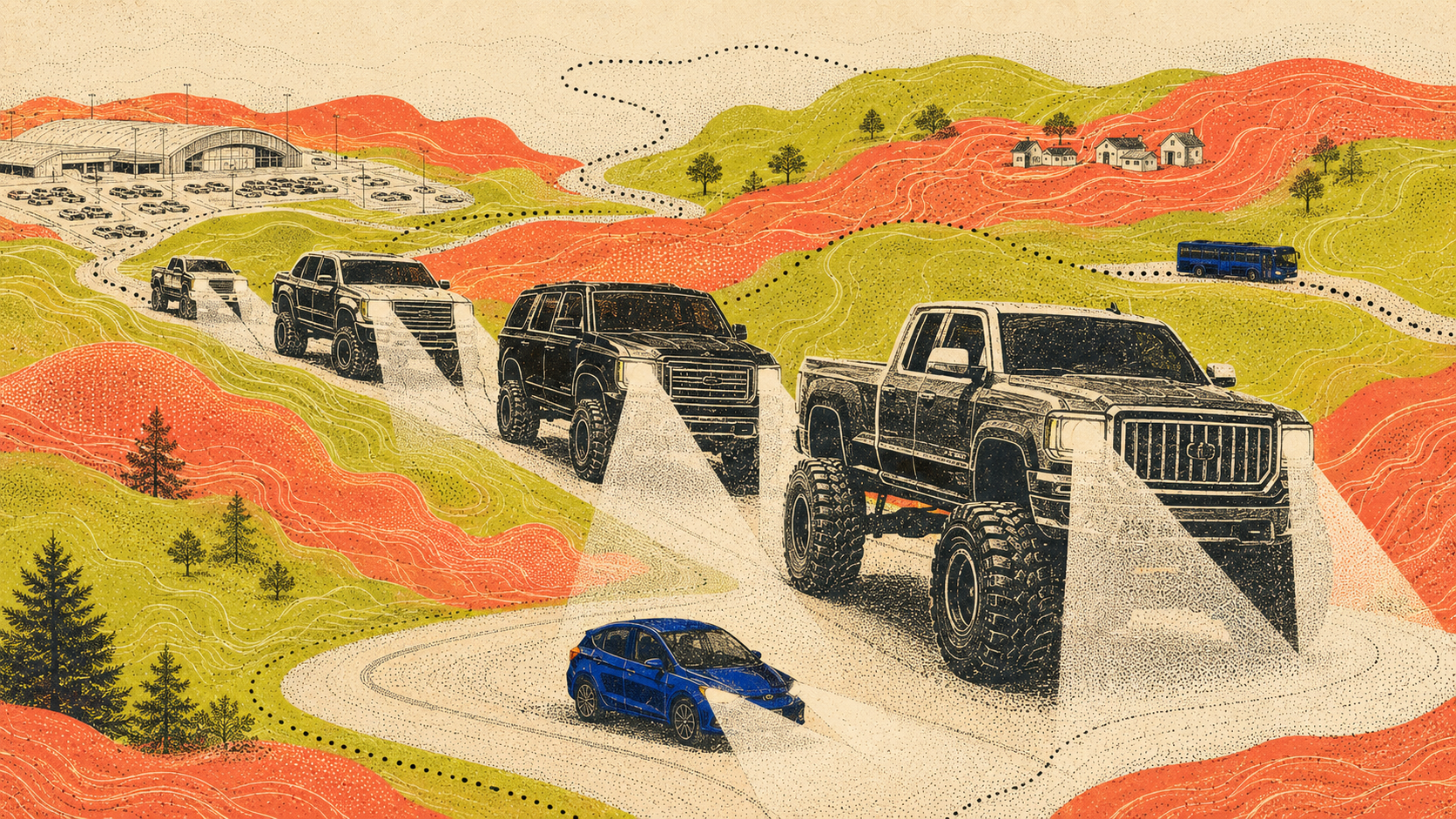
"Why are they high-beaming us?"
"They're not. Those are their low beams."
My husband answered so matter-of-factly that it took me a second to understand him. Surely no manufacturer would design an ordinary headlight bright enough to imitate a searchlight. Then the pickup passed us. It had not been high-beaming us at all. Its lamps simply sat near the height of our windshield.
That exchange has become, in my mind, the perfect introduction to getting around rural Pennsylvania. It was funny because it was literal. A federal study of headlamp glare later gave the moment its physics: as the mounting height of an oncoming lamp rises, discomfort glare tends to rise with it, while a driver's ability to detect objects can fall. The truck did not need illegal lights to overwhelm our car. It only needed to be taller.
When I brought my parents to the United States for the first time, my father - an unapologetic car enthusiast - spent much of the trip marveling at the vehicles. Not sports cars. Not classic American muscle. Pickups.
"They look like bulls," he said.
It was not entirely a joke. Coming from Vietnam, where the scale of the street sets very different limits on the scale of the vehicle, row after row of lifted pickups, Suburbans, Wagoneers, and heavy-duty trucks felt almost zoological. Parking lots resembled agricultural equipment expos. Every driveway seemed to contain something capable of towing a house.
At first, I assumed this was simply rural practicality. People haul lumber, tow trailers, move equipment, and travel roads that are not always kind in winter. A pickup here can be a tool in the most literal sense. But that did not explain all of them. Some were spotless. Some had pristine beds and tires that appeared never to have encountered anything rougher than a Sheetz parking lot. They were working vehicles in design, perhaps, but not necessarily in occupation.
My outsider's impression was not a measurement of Adams County, but it was not imaginary either. The vehicle fleet has changed around all of us. The Insurance Institute for Highway Safety estimates that, over roughly three decades, the average American passenger vehicle became about four inches wider, ten inches longer, eight inches taller, and a thousand pounds heavier. In model year 2024, the Environmental Protection Agency classified 66 percent of new vehicles as trucks under federal rules; truck-based SUVs alone accounted for half of new production. What looked exceptional through my windshield was a local expression of a national shift.
"Nobody announces an arms race. The baseline simply shifts."
The baseline shifts
I began to wonder whether an invisible competition was unfolding. Once everyone owns an F-150, the F-150 no longer feels particularly large. Someone buys an F-250. Someone else lifts theirs. Then come the Suburbans, the Wagoneers, and the three-quarter-ton pickups - whatever can be fitted onto four wheels while stopping just short of becoming registered agricultural equipment.
Nobody announces an arms race. The baseline simply shifts. What counted as enormous a decade ago begins to look ordinary. What once looked ordinary begins to look small. The headlights rise with the vehicles, and so does everyone else's expectation of what feels safe to drive.
Economists and safety researchers have used almost exactly this language. Michelle White called it an "arms race" on American roads: families buy larger vehicles partly for the protection they appear to provide, while transferring risk to people in smaller cars and to those outside cars altogether. Later research by Michael Anderson and Maximilian Auffhammer found that, holding the struck vehicle's weight constant, being hit by a vehicle a thousand pounds heavier raised the baseline fatality risk by roughly 40 to 50 percent. The private feeling of safety and the public distribution of danger move in opposite directions.
Height matters as much as bulk. In crash data analyzed by IIHS, pickups, SUVs, and vans whose front edges rose above forty inches were about 45 percent more likely to kill the pedestrians they struck than lower, sloped vehicles. A tall, blunt front end is less likely to sweep a person onto the hood and more likely to hit the torso. The bull resemblance, it turns out, is not only aesthetic.
There is something almost evolutionary about the result. One species develops a defense, another adapts, and soon an entire ecosystem is reorganized around traits that no individual participant consciously chose. You do not need to want a larger vehicle. You only need to look through your windshield and find yourself surrounded by them.
Everything is far away
Of course, there is another explanation. Everything here is far away.
Adams County covers nearly 519 square miles, and its workers spend an average of 28.2 minutes traveling to work - longer than the Pennsylvania average. In the 2024 American Community Survey estimates, more than three-quarters of workers drove alone. Those numbers do not explain every pickup, but they explain why a vehicle is not an occasional convenience here. It is the connective tissue between home, work, food, health care, and other people.
I play ice hockey, a sport practically synonymous with "drive an hour for recreation." The nearest rink is not around the corner. Neither are many grocery stores, doctors, jobs, or people I spend time with. Distances that might justify a regional train somewhere denser simply become another drive here.
Before I had a practical way to make those journeys, I became intimately familiar with Greyhound schedules and Amtrak waiting rooms. More than once, I boarded a six-o'clock bus and swayed from side to side for an hour, only to arrive in Harrisburg carrying an enormous hockey bag. Apparently, this combination leads strangers to one conclusion.
"Are you a professional player?"
No. Just someone trying to make it to a pickup game.
Those journeys taught me something unexpected: rural Pennsylvania does have public transportation. Rabbittransit operates four local Gettysburg routes and connections toward Hanover and Harrisburg. But existence is not the same as flexibility. As of July 2026, the weekday 15N schedule listed only two departures from Gettysburg - at 6:00 in the morning and 2:55 in the afternoon - and two trips back. That is useful commuter infrastructure. It is not a network on which one can improvise a late hockey game.
What fascinated me most was the place transit occupied in people's imagination. Whenever I mentioned riding the bus, the responses were rarely about schedules, frequency, or routes. They were about the kinds of people presumed to use it.
"The bus is for people who can't drive."
"Rabbittransit is mostly for old people getting to appointments."
"I trust myself driving more."
Driving was not treated as one transportation option among several. It was the default condition of competent adulthood. To drive was to be independent, capable, and trustworthy. To ride the bus suggested that something had gone wrong: age, disability, poverty, or the failure to acquire a license.
That perception reaches beyond the conversations I happened to have. In a study of rural transportation providers and conference participants, researchers found that the personal automobile played an important role in rural culture; losing the ability to drive could reduce independence and self-esteem, while public transit carried a social stigma for many older riders. A bus can run through a town and still remain socially invisible to most of the people living there. If nobody imagines it as transportation for them, its physical presence does little to disturb the rule that everyone drives.
The physics of normalization
Once driving becomes adulthood, the vehicle becomes more than a vehicle. It carries signals about competence, security, work, and self-reliance. A large pickup does not merely transport its owner through the landscape. It communicates that the owner is equipped for the landscape - or at least cannot be overwhelmed by it.
The longer I watched the roads, the less individual the pattern appeared. Long distances make driving necessary. Thin service makes other modes difficult to trust. Driving becomes associated with independence. Larger vehicles make smaller cars feel more vulnerable. That vulnerability encourages still larger vehicles. Roads, parking spaces, dealerships, and expectations gradually adjust around them.
Each choice appears reasonable from inside the system. If I have to drive an hour, I want to feel comfortable. If winter roads are dangerous, I want something substantial. If everyone around me drives a three-ton vehicle, I do not want to sit at bumper height in a compact hatchback. If the bus runs twice in the direction I need - and everyone assumes it is for people who cannot drive - I probably will not consider it unless I have no other option.
No single driver creates the landscape. Everyone merely adapts to it. Then, through all those adaptations, the landscape recreates itself.
That feedback loop also blunts the environmental progress hidden under the hood. New vehicles are more fuel-efficient than they were twenty years ago, but the EPA notes that the market's movement toward larger, less-efficient vehicle types has offset some of the gains made within each category. Better engines are being asked to move more vehicle.
It would be easy to make this a story about foolish consumers buying trucks they do not need. That is not what my field notes show. They show a system that makes vehicle ownership difficult to escape and then makes size feel like prudence. Utility, status, comfort, fear, geography, and habit become difficult to separate because they are all pushing in the same direction.
What interests me, then, is not simply whether Americans drive too much or whether pickups have become too large. Those arguments have already been written. What interests me is the peculiar physics of normalization: the way distance, policy, identity, safety, and machinery reinforce one another until the outcome feels inevitable.
Everyone drives because everything is far away. Everyone drives something enormous because everyone else does.
And after enough time here, even the searchlights shining directly through your windshield begin to look like ordinary low beams.