I finished stick-and-puck exhausted. My legs ached, my gear was soaked, and for the first time all week my head felt quiet.
I was not ready to go home. I wished there were a cafe beside the rink. Somewhere I could order a coffee, open my laptop, and spend an hour writing before driving back. Not because I desperately needed caffeine, but because I was not ready for the day to end. I wanted somewhere to let the feeling continue: tired in a satisfying way, pleasantly anonymous, surrounded by other people without being responsible for any of them.
There was not one. There rarely is.
For months, I blamed the lack of a third place.
The American sociologist Ray Oldenburg popularized the term for the informal gathering places beyond home and work: cafes, pubs, barbershops, parks, diners, and other rooms where people return often enough to become regulars. The ideal third place is easy to enter, inexpensive enough to revisit, and socially undemanding. Conversation matters more than consumption. You come because people are there, and eventually people come because you are there.
It sounded exactly like what I was missing.
Somewhere was always happening
I grew up in Haiphong, Vietnam, where places like that seemed to appear almost by accident. Sidewalk coffee shops spilled into the street. Stores became places to stand and talk. Lakesides filled with exercising folks in the evening. People pulled low stools into whatever patch of public life was available and made a temporary room out of it. There is something almost omnipresent about it.
I do not mean that urban Vietnam was a paradise of effortless community. It could be loud, hot, crowded, and short on privacy. But you could walk out the door without a plan and stumble into life. The distance between solitude and participation was sometimes only a few steps.
Then I went to college. Looking back, universities may be the most successful third-place machines ever built. Libraries, dining halls, laboratories, athletic centers: thousands of people with overlapping schedules continually running into one another. I never had to ask where to go after class. Somewhere was always happening in this rural Pennsylvania college town.
Then I moved to another rural Pennsylvania. Here, somewhere usually required a purpose and a car. I drove to the rink to skate, to the store to shop, to a restaurant to eat. When the purpose ended, the place seemed to close around me. The parking lot waited. The drive home began.
At first I treated this as a simple infrastructure problem. Rural Pennsylvania needed more cafes, more public squares, more places where a person could exist without buying much or explaining why he was there. I still believe that would make life better. But the more I thought about the third-place ideal, the more I noticed a requirement more basic than coffee, chairs, or opening hours.
You have to feel as though you belong there.
I already failed.
"Bureaucracy can certify that I reside here. It cannot certify that I belong here."
Resident alien
Let me get one truth out of the way: I do not yet belong in rural America, not in the effortless way people usually mean belonging. I live here. I know these roads. I know which gas station is cheapest, which rink has the softest ice, and which roads flood after a summer storm. I carry wet hockey gear through its parking lots and call this landscape home. But I have not put down roots. Familiarity with a place is not the same as belonging to it.
U.S. bureaucracy has a phrase I cannot stop thinking about: resident alien. It is supposed to be a technical classification, the sort of administrative language nobody expects to sound poetic. Yet it describes my social life with unsettling precision.
I reside here.
But I remain, in many ways, alien.
Not because anyone has treated me unkindly, but because belonging is not granted by a lease, a driver's license, or an immigration document. It is granted by accumulation. By becoming the person who is expected at the same church every Sunday. The teammate who always arrives early. The neighbor whose porch light everyone recognizes. The customer whose coffee order the cashier remembers before he speaks.
Bureaucracy can certify that I reside here. It cannot certify that I belong here.
The real entrance is an invitation
Then I began to wonder whether I was blaming the wrong thing.
Rural America is not devoid of third places. In a national survey of rural working-age adults, the places people most often used for meaningful social interaction were religious organizations, dine-in restaurants, and parks or lakes. Around me, community also seemed to gather through sports leagues, friends' homes, neighbors' garages, and the diner where the same people occupied the same tables every week.
The issue was not simply that these places did not exist. It was that many of them were embedded in relationships I did not yet have. You went because your cousin volunteered there, because a coworker invited you, because your family had attended for years, because the person with the garage already knew your name. The rural third place was often invisible on Google Maps because the map was social.
I had been looking for the urban version. In a city, a third place often appears to be place-first: you walk into a cafe, return often, recognize faces, and slowly acquire relationships. The movement is: place to relationship to belonging.
Rural social life, at least as I was encountering it, often seemed to run in reverse. You knew someone; that person invited you to church, a garage, a lake, a team, or a gathering; the place became yours because the relationship carried you across its threshold. The movement was: relationship to place to belonging.
The distinction is too tidy to be a universal law. Cities can be intensely closed, and rural communities can welcome a newcomer with astonishing speed. But it explained my particular mistake. I kept searching for a public room that would let me belong before anybody knew me. Many of the rooms around me worked the other way. The building had a door. The real entrance was an invitation.
Rooms without addresses
My husband rarely complains about not having a third place. He comes home, puts on a headset, logs into Discord, and spends hours talking with the same friends he has known for years. They play, gossip, argue, drift in and out, and notice who has not appeared. I had dismissed that arrangement because it did not have an address. Yet researchers studying Discord communities have found many of the qualities Oldenburg associated with third places: regulars, low-pressure conversation, shared activities, and the freedom to enter and leave without ceremony.
Perhaps my husband had not failed to find a third place. He had carried one home in his headset. I was searching for a room full of chairs. He already had the more important parts: people, ritual, repetition.
Then there was Dollar General.
One evening my husband looked at me and said, "I'm bored. I want to go to Dollar General."
At first I chuckled. Who gets bored and goes to Dollar General? Then I realized I had done the same thing. We were not shopping. We were wandering. We browsed because we wanted somewhere that was not home, somewhere bright and open where twenty minutes could pass without requiring a plan.
Dollar General had accidentally become our promenade.
It was not a third place in the Oldenburg sense. Conversation was not the main activity. The store did not invite us to linger, and browsing did not make us regulars in one another's lives. It was a place being asked to perform a small fraction of a third place's work. When there is nowhere to go, anywhere becomes somewhere.
That is funny until it is not. A retail aisle can interrupt cabin fever, but it cannot by itself produce community. We did not need another object from the shelf. We needed a reason to remain among other human beings.
The slow work of becoming familiar
None of this makes physical places irrelevant. The supply of third places is uneven, and rural communities often have fewer accessible options than urban ones. A cafe beside the rink would lower the cost of lingering. It could turn separate people with the same schedule into familiar faces. Oldenburg's insight matters precisely because repeated, unplanned contact gives relationships somewhere to begin.
But a coffee shop would offer a possibility, not a cure. I could sit there every week and still remain a customer who happened to be alone. A room cannot guarantee belonging any more than an address can guarantee a home.
I kept searching for a place. What I was actually searching for was a relationship.
The frustrating part is that the two needs loop into one another. You cannot belong to a place until you have built relationships. Yet places are often how relationships begin. A newcomer needs an invitation in order to enter some rooms, but he also needs rooms where an invitation is not required. There is no clean way out of that paradox, only the slow work of becoming familiar.
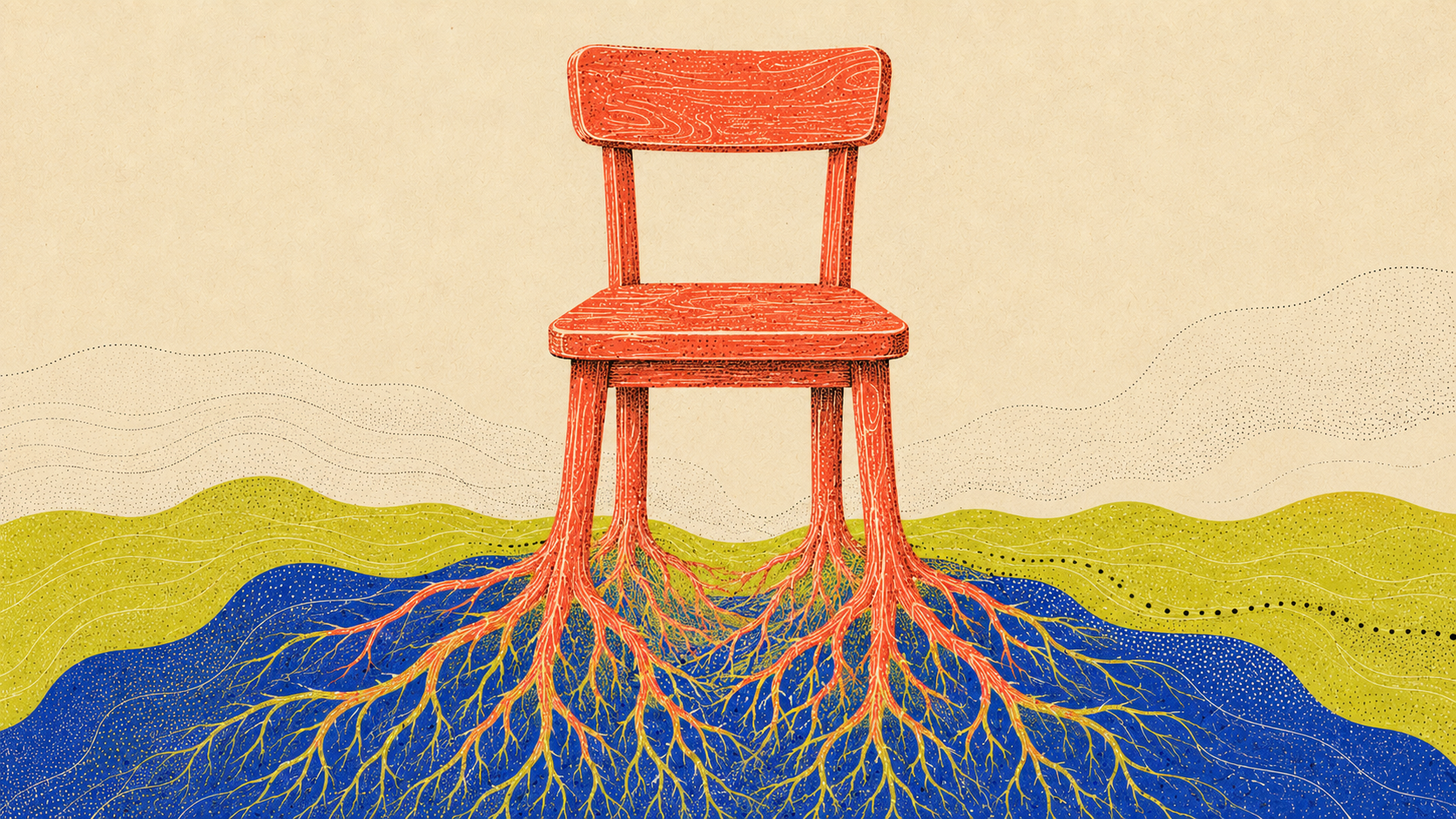
Perhaps taking root is less dramatic than I imagined. It is returning to the same rink. Learning one more name. Staying ten minutes after the skate instead of vanishing into the parking lot. Accepting an invitation, then eventually making one. A root does not arrive as proof that it belongs. It grows by making contact, repeatedly, with the same ground.
I still wish there were a cafe beside the rink. I would order a coffee, open my laptop, and let the day end slowly. I think that small piece of infrastructure would make my life better.
But I no longer believe that a cafe alone would solve my loneliness.
A third place is not just a room filled with chairs. It is a place where someone notices when you do not show up.
I thought I needed a third place. It turns out I needed to take root.