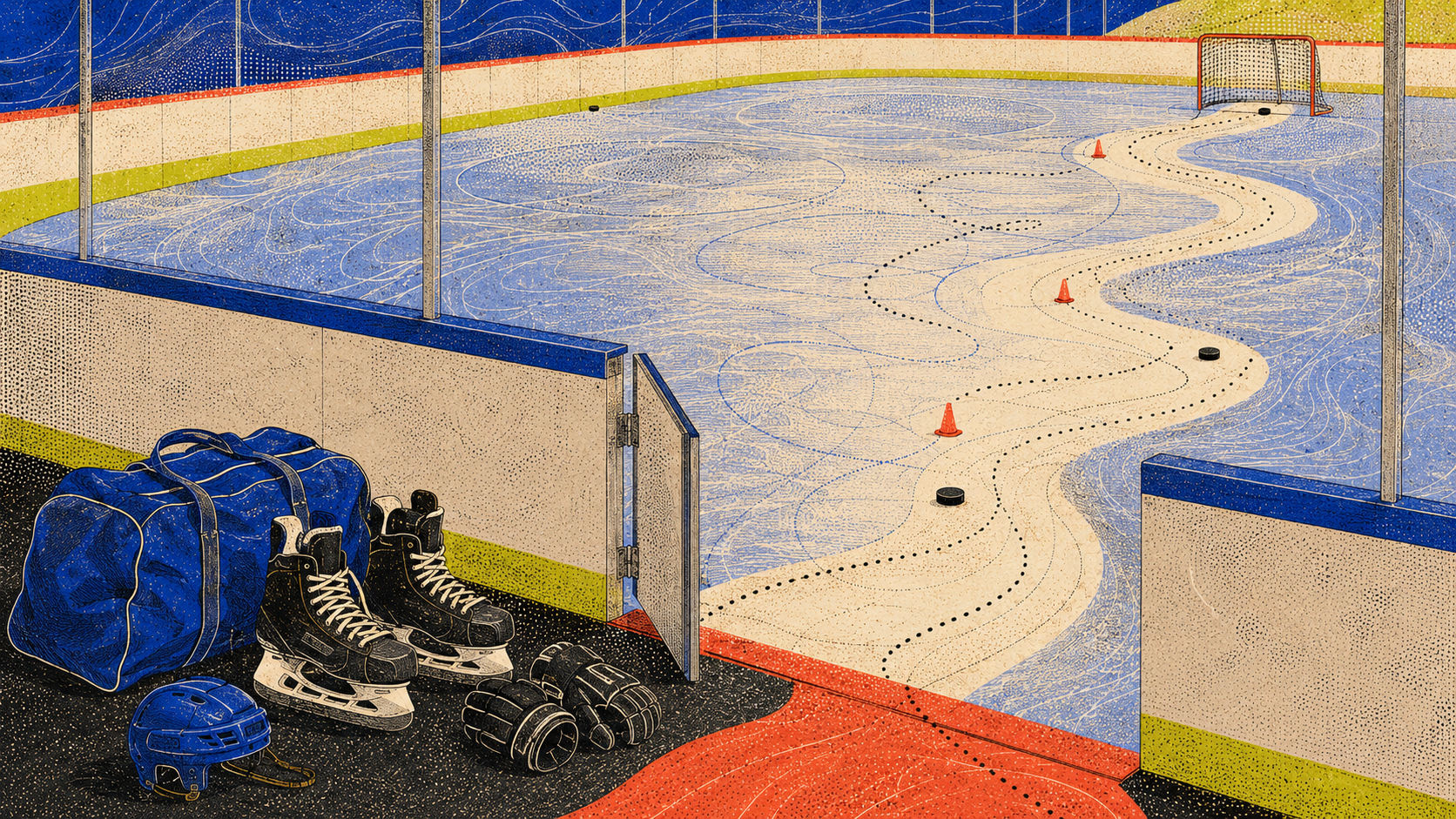
The fluorescent lights made everyone in the rink lobby look tired. Skate guards scraped across the rubber floor. Parents held paper coffee cups and stared at their phones. A row of teenagers slumped against the wall with the particular misery of people whose summer had been interrupted for their own improvement.
And then there was me.
I was waiting for "power skating" with my hockey bag at my feet. I had encountered the phrase during a random Reddit scroll and decided immediately that I needed it. I love hockey. I am willing to do almost anything within my domain to become better at it. The class existed, I could drive there, and my credit card worked. That was enough.
There was nothing wrong with wanting to skate better. Yet sitting there, I felt as if I had misunderstood the invitation.
The children had parents to lace skates, carry water bottles, and authorize the expense. The teenagers had been deposited between other summer activities and could blame an adult for their presence. They knew who might make the next AA team and who had been scandalously sidelined by a cutthroat coach. I knew none of this.
I had paid for the lesson with my own money. I had checked the schedule, packed the car, and driven myself there. Nobody had made me come.
Which somehow made it more embarrassing.
I looked around the lobby and wondered: Why were there not more adults here?
Visibly unfinished again
Adults were everywhere else in the rink. They played pickup and beer league. They coached. They watched from the stands. They compared sticks, complained about ice fees, and spent astonishing amounts of money on equipment designed to protect bodies that still had to go to work the next morning.
But in the instructional spaces I knew, the population changed. Skill clinics seemed to belong to children. Power skating seemed to belong to teenagers. Adults appeared once the activity had become a game, as though competence had already been established somewhere offstage.
There were obvious reasons. Youth teams created a steady demand for clinics. Parents built calendars around development. Adults had work, money, injuries, and limited time. Those explanations accounted for the room. They did not account for the shame I felt sitting in it.
Perhaps adult beginners were more common than I realized. Perhaps I simply noticed the children because I had become painfully aware of my own age. Whatever the explanation, I could not shake the feeling that I had arrived somewhere I was no longer expected to be.
A child at a lesson looked ordinary. An adult at the same lesson looked as though he had chosen to become visibly unfinished again.
The children had an alibi. They were there because somebody cared about their future. I was there because I cared about my own.
"A child at a lesson looked ordinary. An adult at the same lesson looked as though he had chosen to become visibly unfinished again."
The question
Harrisburg is my second hometown, mostly because Twin Ponds is there. It is the rink where I learned to play hockey, which means it is also the rink where several versions of me have looked ridiculous.
At one pickup session, after I had improved noticeably in a short amount of time, another player skated over to me. We were resting near the boards, breathing hard through our cages.
"You must have played a sport before, right?"
No. I had not grown up athletic. As a feminine-presenting child in Vietnam, I was steered early and often toward the quiet, the careful, the indoors, the individual, not teams. Sport belonged to a version of childhood I was told, in a hundred small ways, was not mine to try on. By the time I had enough freedom to choose otherwise, I was already an adult.
He looked at me for a moment. "Then why would you do this to yourself?"
I laughed. He did not.
The question was friendly, and entirely reasonable. Hockey is difficult, expensive, inconvenient, and unusually effective at making a grown person feel uncoordinated. Many of the people I met at adult pickup arrived with some athletic inheritance: balance, game sense, the memory of being coached, or at least the bodily confidence of having once belonged in sports.
I had chosen a high learning curve after the socially acceptable period for having one. Why would anyone do that to himself?
The question has bothered me ever since.
Public apprenticeship
Once I began noticing it, the pattern extended far beyond hockey.
Adults learn beginner piano, beginner ballet, beginner pottery, and beginner tennis. But watch what happens when they make the mistake their level requires. They apologize to the teacher. They laugh before anyone else can. They explain that they have never been coordinated, artistic, musical, athletic, or good with languages, as though the failure needs to be placed inside a permanent identity before anybody mistakes it for hope.
Children are allowed to rehearse in public. Their errors are evidence that childhood is working as intended. Adults are expected to arrive formatted. We can acquire new skills, certainly, but we are supposed to conceal the ugly stage until the result is presentable.
What unsettled me in the rink lobby was not simply being bad at something. It was being seen in the process of wanting.
There should be a phrase for that condition: public apprenticeship. The period when desire has become visible but ability has not yet caught up. You have bought the instrument. Enrolled in the class. Put on the skates. Everyone can see the person you are trying to become, and everyone can also see that you are not that person yet.
Failure in private can remain hypothetical. Failure in public acquires witnesses.
The witnesses may not even care. The teenagers in the lobby were far more interested in their own lives than in mine. But embarrassment does not require a hostile audience. Sometimes it needs only the possibility that somebody has noticed how badly you want what you cannot yet do.
Out of sequence
I grew up assuming competence was something a person accumulated. You did a thing badly, then less badly, then perhaps well. Somewhere in adulthood I noticed people had stopped talking that way. Ability had become identity. Not athletic, not musical, not a math person - verdicts issued before the first attempt, so the attempt could never actually be graded.
Sport makes the switch especially easy, because athletic identity is usually built before anyone is old enough to consent to it. At the rinks I knew, adults who played were assumed to have once been sports kids. Recreational leagues were full of people returning to something their bodies already recognized. The adult beginner arrives without that origin story. He is not returning. He is trespassing forward.
At power skating, the children were exactly where the culture expected unfinished athletes to be. I was out of sequence.
That was what my credit-card payment exposed. Nobody had invested in my potential. I had invested in it myself.
The ice keeps a record
Hockey makes it almost impossible to hide the ugly phase.
On land, I can choose the angle of a video or repeat a movement until one attempt looks competent. The ice offers fewer editorial privileges. A weak outside edge leaves the circle. A bad pass keeps sliding. A missed catch announces itself against the boards. When I fall, an adult in full equipment makes a sound much heavier than a child.
At stick-and-puck, I have stood alone firing pucks at the wall while other players ran drills that seemed to contain a private grammar. At clinics, I have watched children understand a movement before I could translate the instructor's words into my feet. I have practiced keeping my head up, only to look down again when my body stopped cooperating.
The ice does not care how intelligent my explanation is. It keeps a physical record of what I can actually do.
That record is not entirely cruel. It also preserves improvement. A turn that once required thought becomes automatic. A weak-side stop appears, briefly, then returns. Someone at Twin Ponds looks at me and assumes I must have played another sport. The same visibility that exposes incompetence eventually makes progress undeniable.
But there is no montage. Improvement arrives with all the waiting left in. I have to inhabit every unflattering version of myself between the first attempt and the thing I hoped to become.
The humiliation of caring
We admire people who are good at things. We admire the fluent speaker, the effortless skater, the ceramicist centering clay as if the material has agreed to cooperate. We admire the clean paragraph and the confident driver.
We rarely admire the version of that person who dropped every pass, mispronounced every word, collapsed every cylinder, stalled at the intersection, or wrote terrible first drafts. Mastery is an edited story. Apprenticeship is everything the edit removes.
Perhaps that is the humiliation of caring. Indifference is elegant. If I do not care, failure cannot reveal anything about me. Caring makes a claim on the future, then forces the present to stand beside the evidence that the claim has not yet come true.
I could quit hockey and recover a certain kind of adult dignity. I would no longer be the grown man in the children's clinic or the late beginner retrieving another bad pass. Nobody could accuse me of taking a recreational pursuit too seriously.
But dignity can be avoidance with excellent posture.
Hockey has forced me to live inside apprenticeship longer than anything else I have loved. It has not taught me that effort always wins or that every dream is available to anyone who wants it. Bodies have limits. Money, time, health, and opportunity have limits. Some late starts remain late.
What it has taught me is smaller and, to me, more useful: being unfinished is not an emergency. Embarrassment is survivable. A person can look ridiculous and continue.
The rink door opened. The teenagers stood. Parents looked up from their phones. Skate guards came off, blades met the rubber floor, and the line began moving toward the ice.
I pulled on my helmet and went with them.
Nothing about my situation had changed. I was still one of the oldest beginners there. I had still chosen this. I was still embarrassed by how much I cared.
Then the whistle blew, and there was no time left to appear finished.
Maybe that is why I keep coming back, not because hockey has made me feel talented, but because it keeps asking me a question adulthood usually lets me avoid: How much of looking stupid am I still willing to endure for the chance of becoming someone new?